Cuisine guide
Thai Home Cooking: A Cook's Guide to Balance & Flavour
How Thai home cooking actually works — the four-flavour balance, the pantry, curries, stir-fries and salads — with the techniques that make each dish reliable.
By Maya Chen
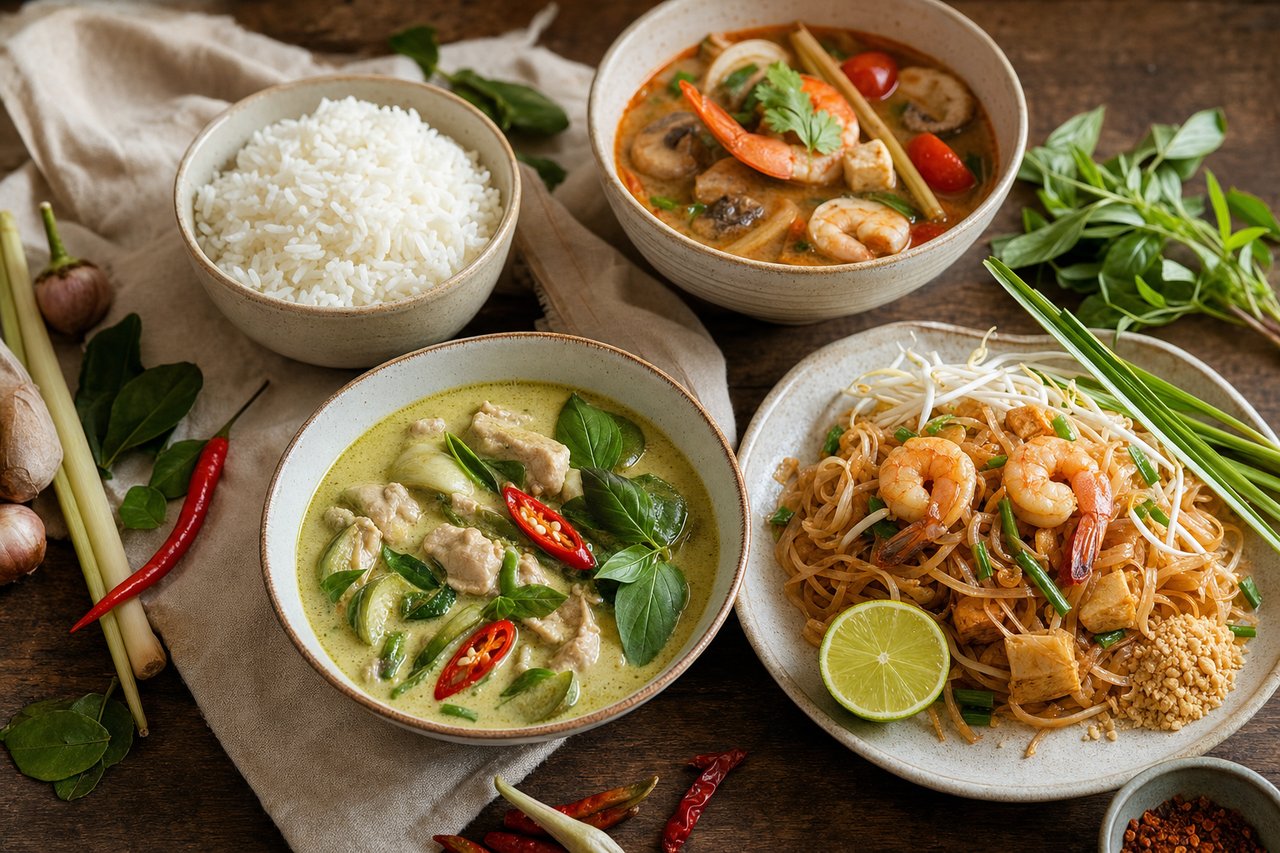
Thai home cooking has a reputation for being elaborate, but at the stove it is fast, intuitive and built on a single organising idea: balance. Where many cuisines lean on one or two dominant flavours, a Thai cook is constantly tasting and adjusting heat, sourness, saltiness and sweetness against each other until the dish sits in equilibrium. Understand that habit, stock a compact pantry, and most of the repertoire becomes approachable in a home kitchen.
This guide works through the cuisine the way a cook actually meets it: first the tasting habit that underpins everything, then the pantry that supplies the flavours, then the major families of dishes — curries, stir-fries, salads and soups — and finally rice and the shape of a shared meal. None of it requires rare skill. It requires good ingredients, a hot pan, and a willingness to taste and correct as you go.
The four-flavour balance
The defining technique of Thai cooking is not a knife skill or a piece of equipment — it is a way of tasting. Almost every savoury dish is tuned across four axes at once: hot from chillies, sour from lime juice or tamarind, salty from fish sauce, and sweet from palm sugar. A good cook adds a little, tastes, and corrects: a squeeze more lime if it tastes flat, a pinch of sugar if it bites too hard, a dash more fish sauce if it tastes thin. None of the four should win outright. This is why Thai recipes so often end with “season to taste” rather than fixed quantities — the balance is the dish, and it shifts with the sourness of your limes and the saltiness of your fish sauce.
It helps to think of the four as levers that pull against each other. Sweetness rounds off harsh heat; sourness lifts a dish that tastes heavy; salt deepens everything. Once you start tasting this way, you stop following recipes blindly and start cooking the way Thai home cooks actually do.
How the balance shifts by region
The four tastes are constant, but their proportions change across the country. Central Thai cooking, the style most familiar abroad, tends toward a rounded sweetness, often from palm sugar and coconut. Northeastern (Isan) food leans hard into sour and salty, with a fiery edge and very little sweetness — its salads and grilled meats are sharp and direct. Southern Thai cooking is the hottest of all, built on dried chillies, turmeric and a heavier hand with shrimp paste. A dish is not simply “Thai”; it carries the accent of where it comes from, and the balance tilts accordingly.
Bitter and umami: the quiet fifth and sixth
Although hot, sour, salty and sweet do most of the work, a thoughtful cook also notices bitterness and savoury depth. Charred edges on grilled meat, bitter greens, and the gentle astringency of certain herbs all add shading that keeps a dish from tasting one-dimensional. Umami arrives through fish sauce, shrimp paste and fermented elements, and it is what makes a balanced Thai dish taste full rather than merely sharp. You do not chase these the way you chase the core four, but learning to recognise them explains why a dish can be perfectly balanced and still taste flat without them.
The pantry that does the work
A short list of ingredients carries most of the cuisine. Fish sauce (nam pla) is the primary source of salt and savoury depth, used the way other kitchens use salt. Palm sugar brings a soft, caramel-edged sweetness that white sugar can approximate but never quite match. Limes and, for the central and southern dishes, tamarind supply the sourness. Chillies — fresh bird’s eye for sharp, immediate heat and dried red chillies for a deeper, smokier burn — provide the fire.
Then come the aromatics that give Thai food its unmistakable perfume: galangal, a harder, more medicinal cousin of ginger; lemongrass, bruised and sliced for its citrus fragrance; and kaffir lime leaves, torn or finely shredded for their floral lift. Add jasmine rice, a jar or two of curry paste, and a can of coconut milk, and a remarkable range of dishes is within reach. Buy fish sauce and curry paste from a Thai or pan-Asian grocer where you can; the supermarket versions are often milder and sweeter than the real thing. A fuller breakdown of these staples lives in the pantry guide, which is worth a glance before a first shop.
Choosing and using fish sauce
Not all fish sauce is equal. The best bottles list only anchovy and salt, are amber rather than dark brown, and smell clean and briny rather than muddy. A good fish sauce seasons without shouting; a poor one tastes harsh and one-note. It keeps for a long time in the cupboard, so it is worth buying a quality bottle and using it as the default salt for savoury Thai dishes. Add it early to soups and curries where it can mellow, and at the end of stir-fries and dressings where its fresh saltiness should stay forward.
Palm sugar, limes and tamarind
Palm sugar comes as soft pale discs or a thick paste and dissolves into a mellow sweetness that carries a faint caramel note. Shave or chop it, and warm it gently if it has set hard. Fresh limes are non-negotiable for the sour side — bottled juice tastes flat by comparison — and a bag of them is the most-used item in many Thai kitchens. Tamarind, sold as a sticky block or a ready-made concentrate, supplies a deeper, fruitier sourness for dishes like pad thai and many central curries; soak a block in warm water and strain it to make your own pulp.
Aromatics: galangal, lemongrass and kaffir lime
These three are the soul of Thai fragrance. Galangal is firmer and more piney than ginger and should not be swapped for it — the flavour is genuinely different. Lemongrass needs the tough outer layers stripped away; bruise the tender core and slice it finely, or leave it in bruised lengths to be fished out later. Kaffir lime leaves are used torn (to scent a broth) or shredded as fine as possible (to eat in a salad or curry). All three freeze well, which is the practical answer for cooks who cannot find them fresh every week — buy a stock and keep it in the freezer.
Making versus buying curry paste
Thai curries begin with a paste — a pounded mixture of chillies, garlic, shallots, galangal, lemongrass, kaffir lime and shrimp paste that does the aromatic heavy lifting. You can pound your own in a granite mortar (the most rewarding route, and the one that gives the smoothest paste) or start from a good shop-bought paste and refresh it with extra fresh aromatics.
Pounding by hand is the traditional method, and it produces a paste that is brighter and more fragrant than a machine can manage, because the pestle crushes the fibres and releases the oils rather than simply chopping them. Start with the hardest, driest ingredients — soaked dried chillies, then galangal and lemongrass — and work down to the softer garlic and shallot, adding a pinch of salt early to help break everything down. It is a workout, and twenty minutes is not unusual for a smooth paste.
A food processor is the realistic compromise for most weeknights. It will not match the mortar, but with a splash of water to keep the blades moving and patience to scrape down the sides, it makes a serviceable paste. The honest middle path, though, is a good jarred paste from a Thai grocer, woken up with a little extra fresh lemongrass, galangal and kaffir lime fried in alongside it. What matters far more than the source of the paste is what you do with it next.
Curries and the art of frying the paste
The technique that makes or breaks a curry is frying the paste. Split a can of coconut milk so the thick cream rises, then fry the paste in that cream over medium heat until it darkens, splits and turns intensely fragrant — this is where the raw edge cooks off and the flavours bloom. Only then do you add the rest of the coconut milk, the protein and vegetables, and finally the seasoning. Rush this step and the curry tastes raw and harsh; give it the few minutes it needs and the whole dish deepens.
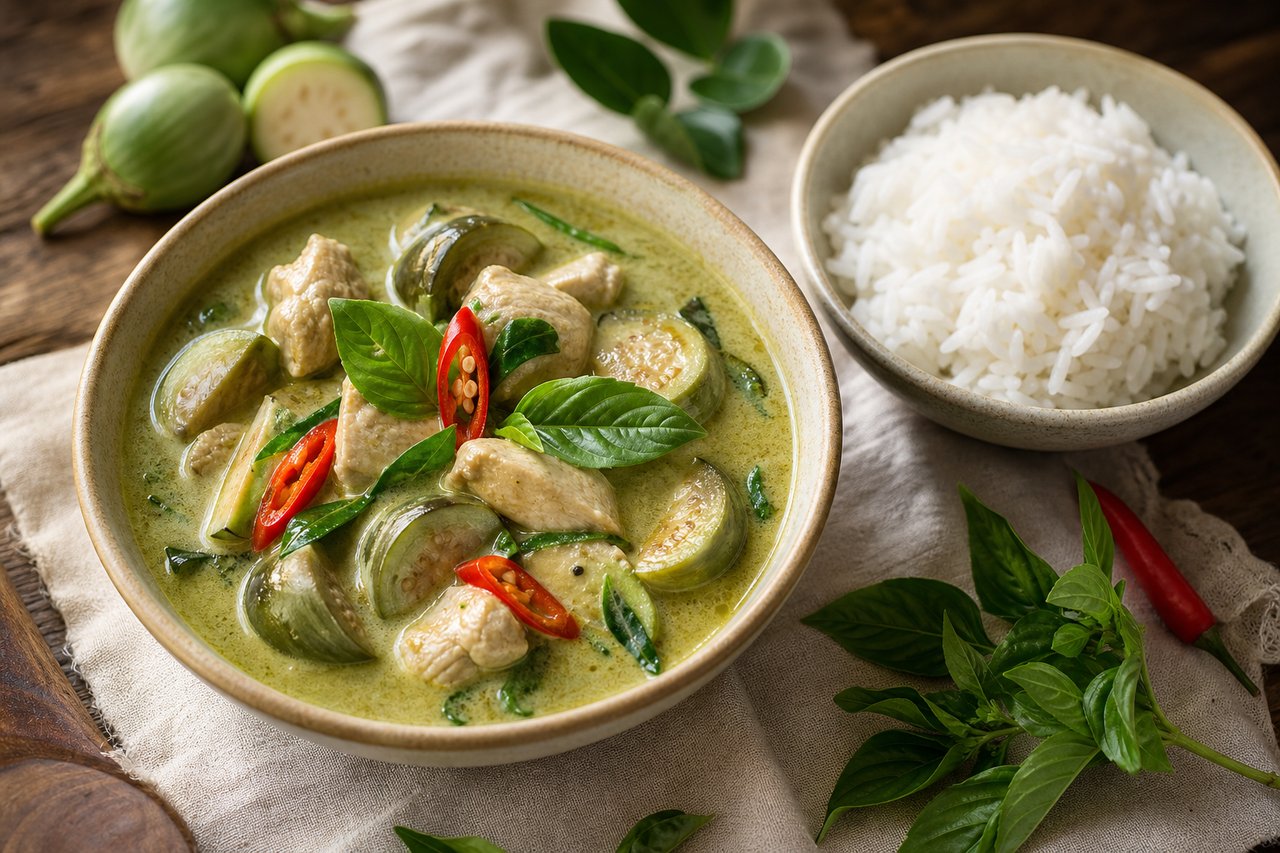
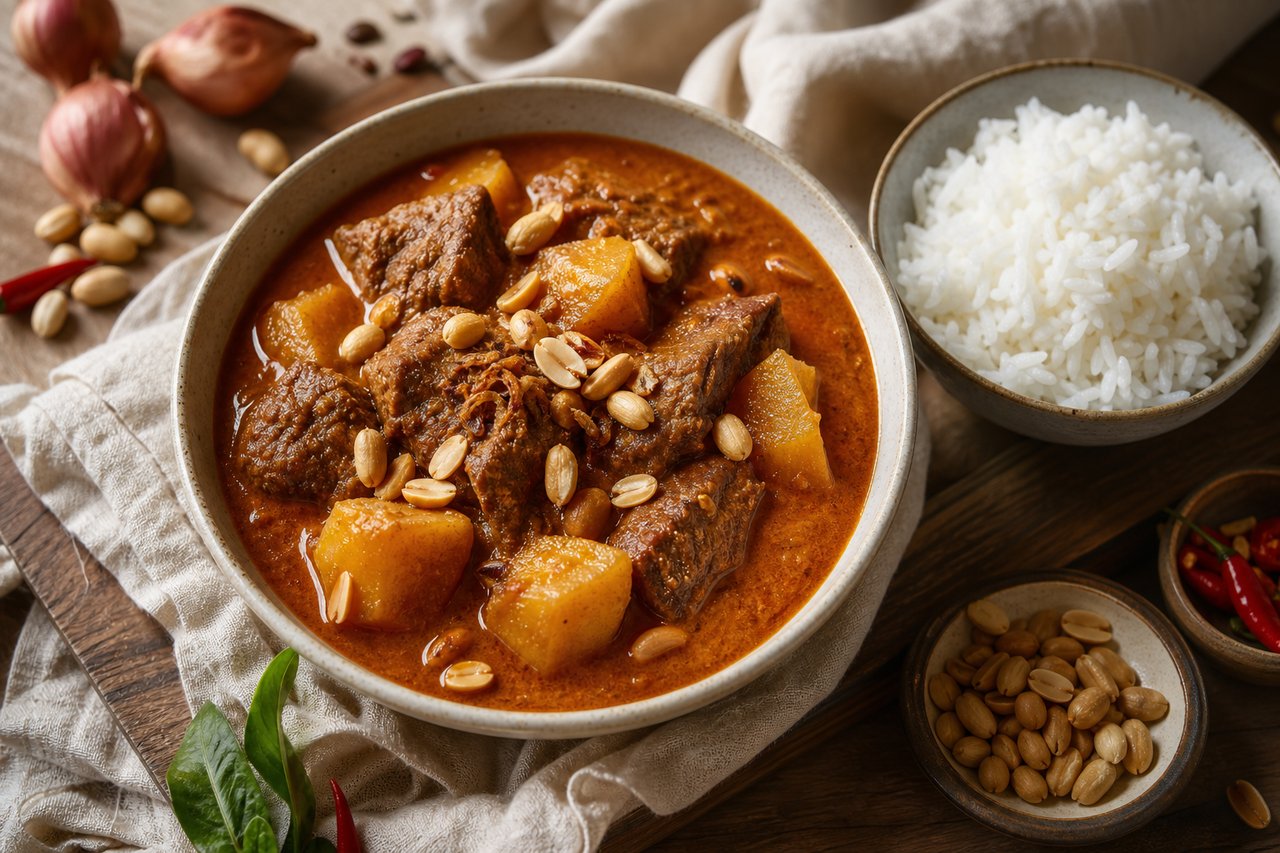
A bright Thai green curry leans on fresh green chillies and herbs and tends to be fragrant and lively, while a massaman curry folds in warm spices like cardamom and cinnamon, along with potatoes and peanuts, for a milder, almost stew-like comfort that shows the Persian and Indian influence on southern Thai food. Red curries sit between the two, built on dried red chillies for a rounder, deeper heat. The method is the same across all of them; only the paste — and therefore the colour and character — changes. The dedicated guide to building Thai curry flavour walks through the splitting, frying and seasoning sequence in detail and is the best next step for anyone who wants their curries to taste fully developed.
Coconut milk deserves a word of its own. Full-fat tinned coconut milk gives the richness a curry needs; light versions tend to split unpleasantly and taste thin. Do not shake the tin before opening if you want to skim the thick cream from the top for frying the paste — that separation is useful, not a defect.
Stir-fries and wok cooking
Stir-fries are the backbone of everyday Thai eating — fast, hot and built to order. The principle is high heat and constant movement: get the wok smoking, add aromatics, then the protein, then sauces and vegetables in quick succession so everything sears rather than steams. Have every ingredient prepped and within reach before the wok goes on, because once it does there is no time to chop. A wok holds and concentrates heat better than a flat pan, but a heavy skillet on the hottest burner will do if you cook in smaller batches to keep the temperature up.
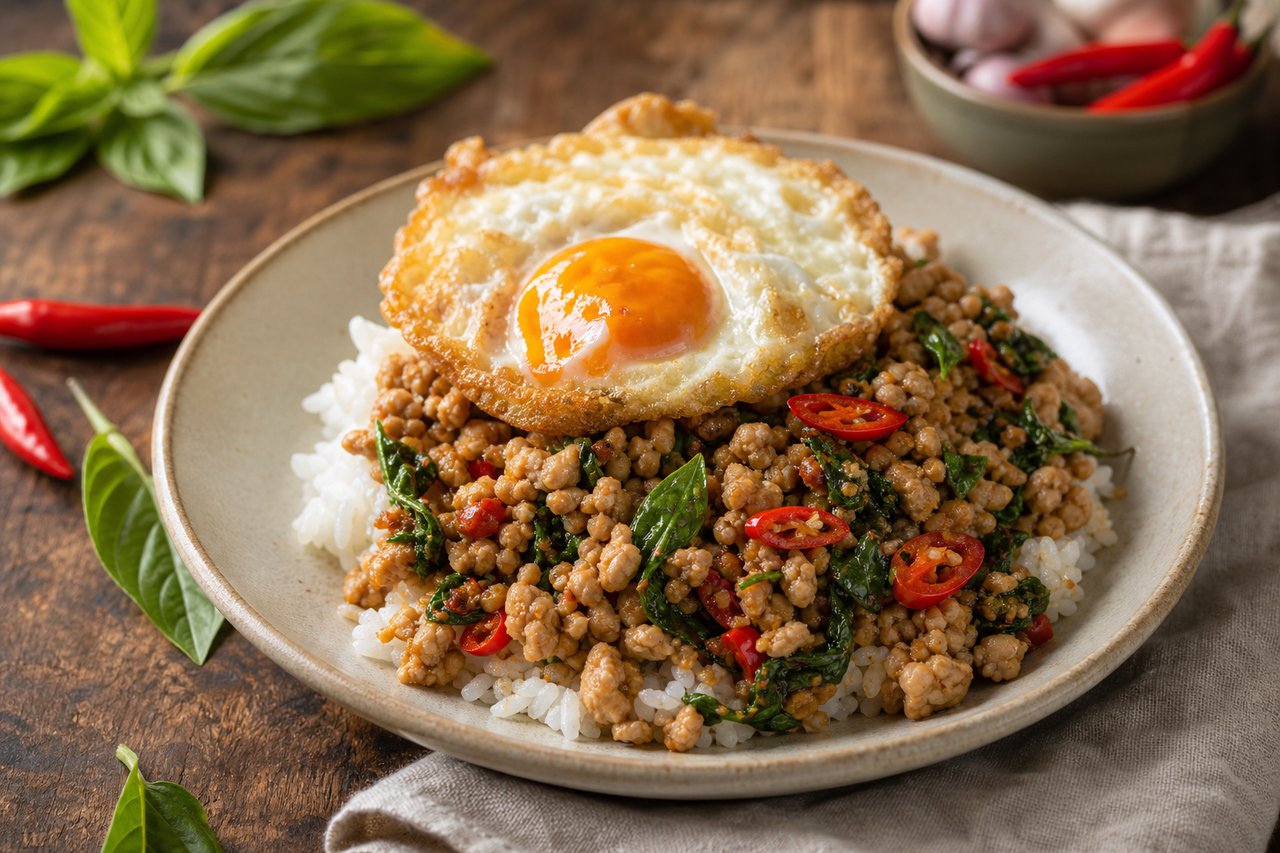
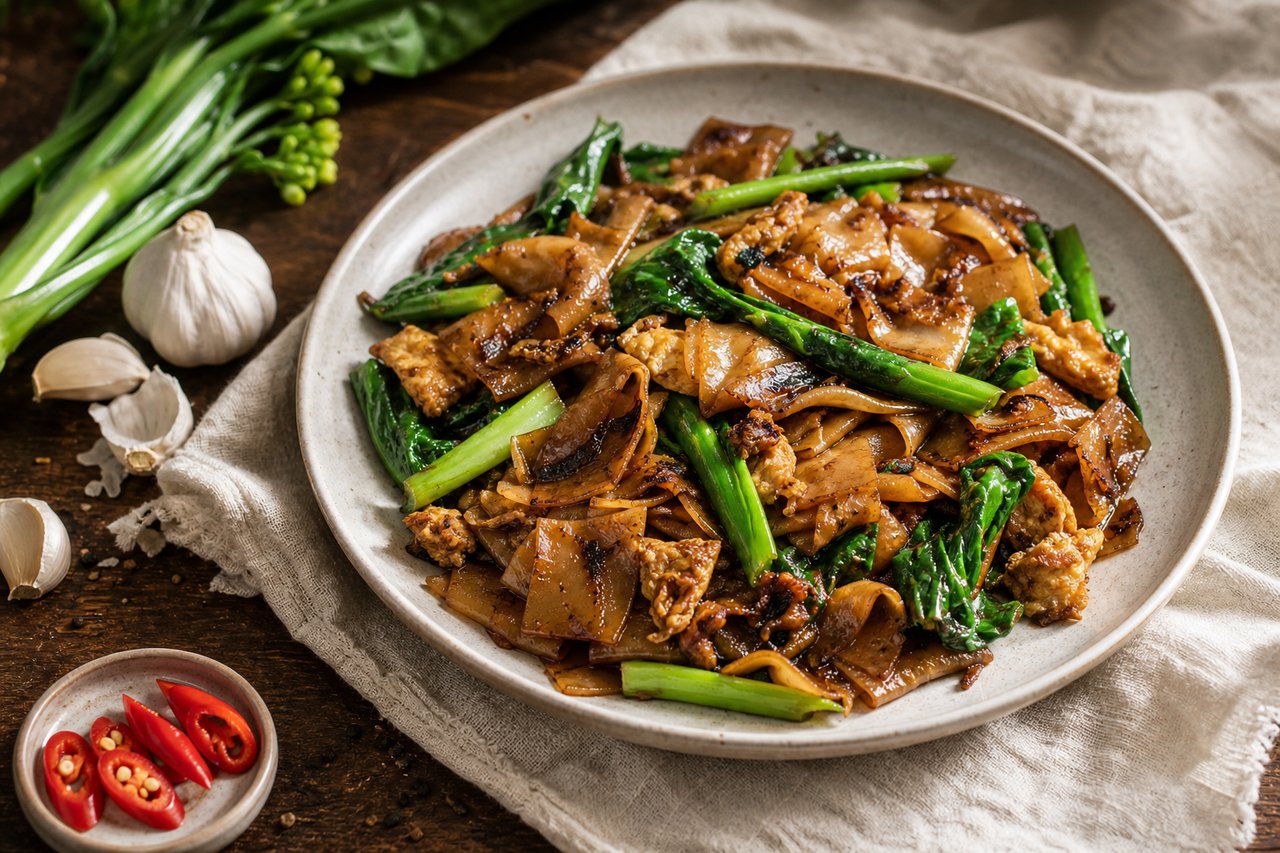
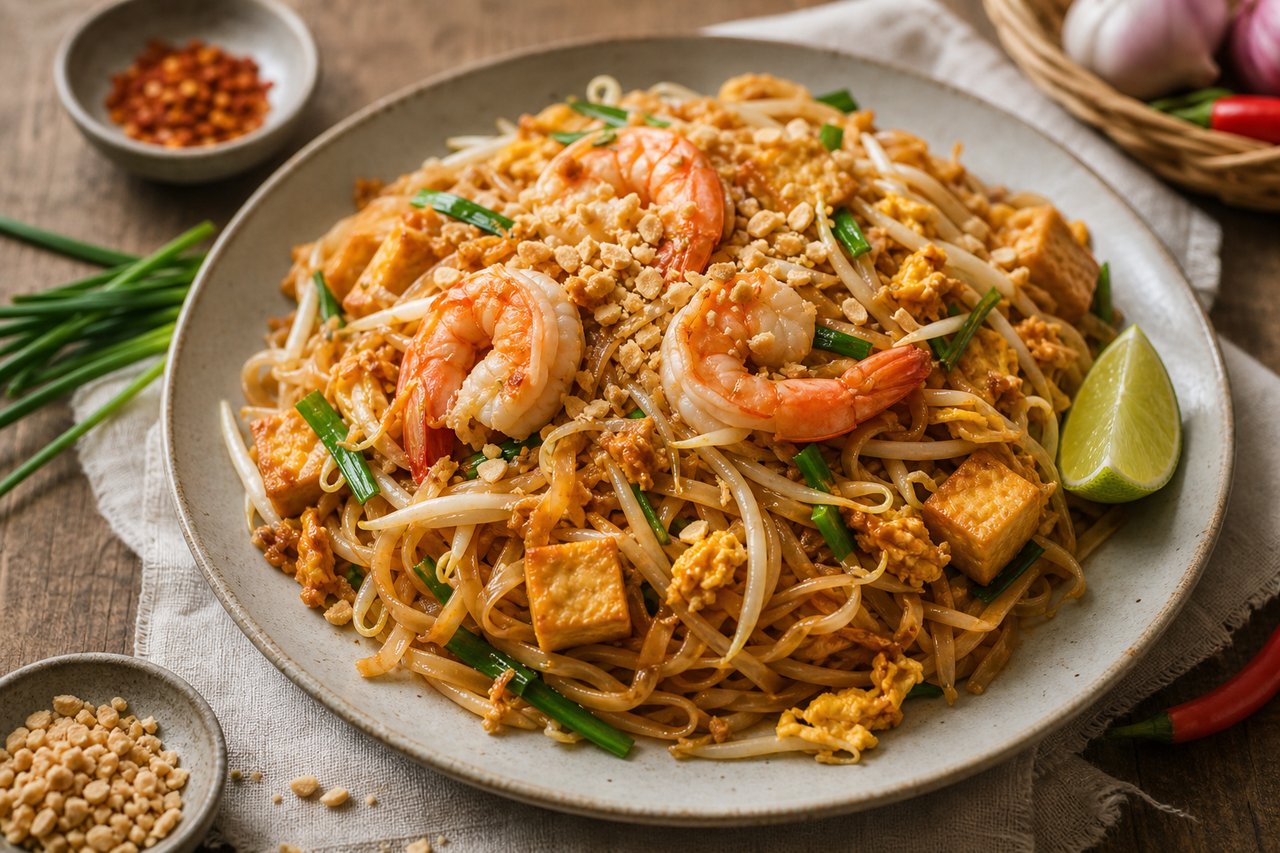
The most famous of all, pad thai, is a stir-fried noodle dish balanced on tamarind, fish sauce and palm sugar — the four-flavour idea in noodle form, finished with crushed peanuts, bean sprouts and a wedge of lime. Equally iconic is pad krapow, minced meat fried hard with garlic, chilli and holy basil and served over rice with a crisp fried egg — arguably the most-eaten quick meal in Thailand. For a gentler, family-friendly noodle, pad see ew sears wide rice noodles in a dark, slightly sweet soy sauce with egg and greens, carrying the smoky char known as wok hei. All three reward a hot pan and a confident hand more than any special skill.
Salads: som tam and beyond
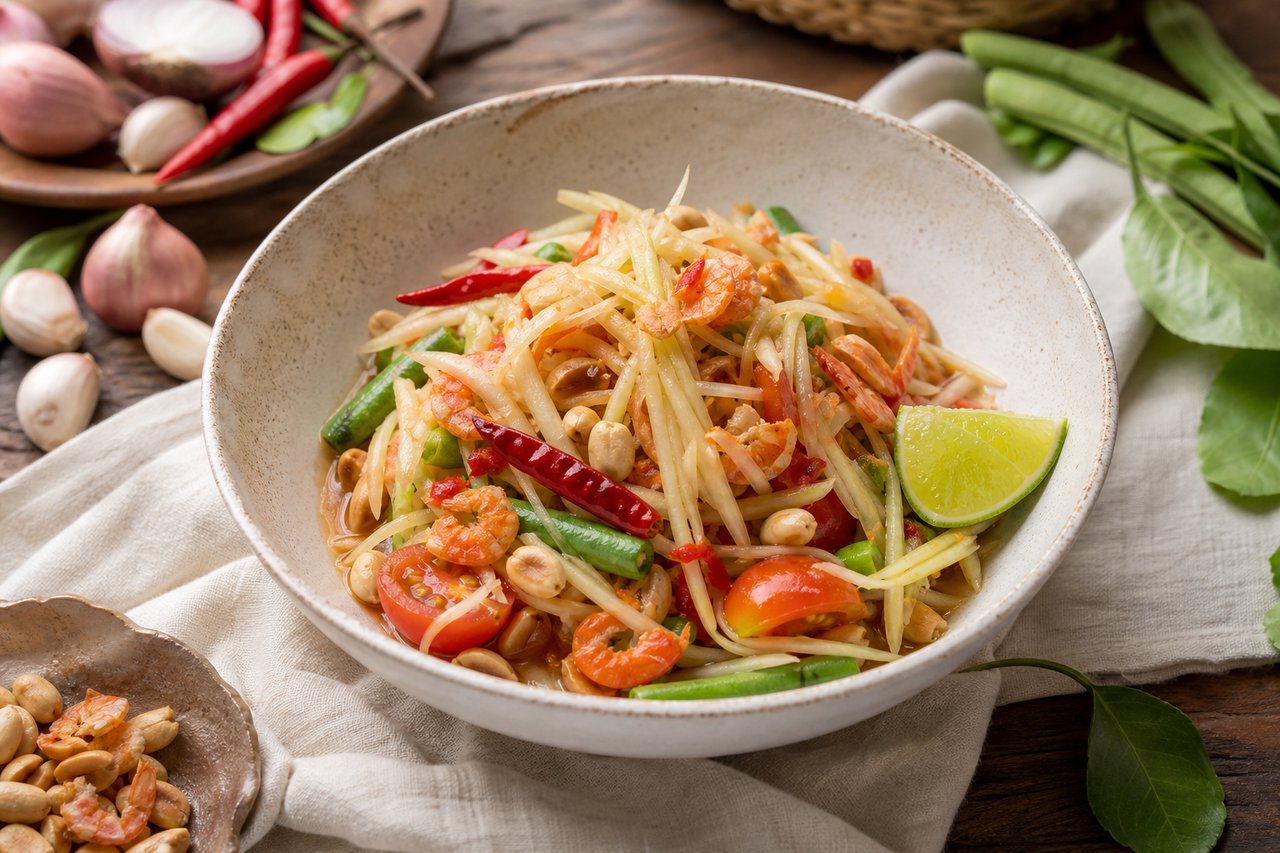
Thai salads are not side dishes — they are bold, punchy plates in their own right, and they show the four-flavour balance at its most direct. Som tam, the green papaya salad of the northeast, is pounded in a tall clay mortar: garlic and chillies first, then palm sugar, lime, fish sauce and tamarind, then shredded unripe papaya, long beans, tomatoes and peanuts, bruised just enough to drink in the dressing without turning to mush. The result is hot, sour, salty and sweet all at once, with a crunch that stays intact — a model of the whole cuisine in a single bowl.
The same logic drives larb (a minced-meat salad sharp with lime, fish sauce, chilli and toasted ground rice that adds a nutty crunch) and yam (a family of tangy tossed salads built on anything from glass noodles to grilled seafood). None of them is cooked for long, if at all; the work is in the dressing and the tasting. These salads pair naturally with sticky rice and grilled meat, and they are where a cook learns most quickly how the four tastes behave, because there is nowhere for an imbalance to hide.
Soups and the place of tom yum
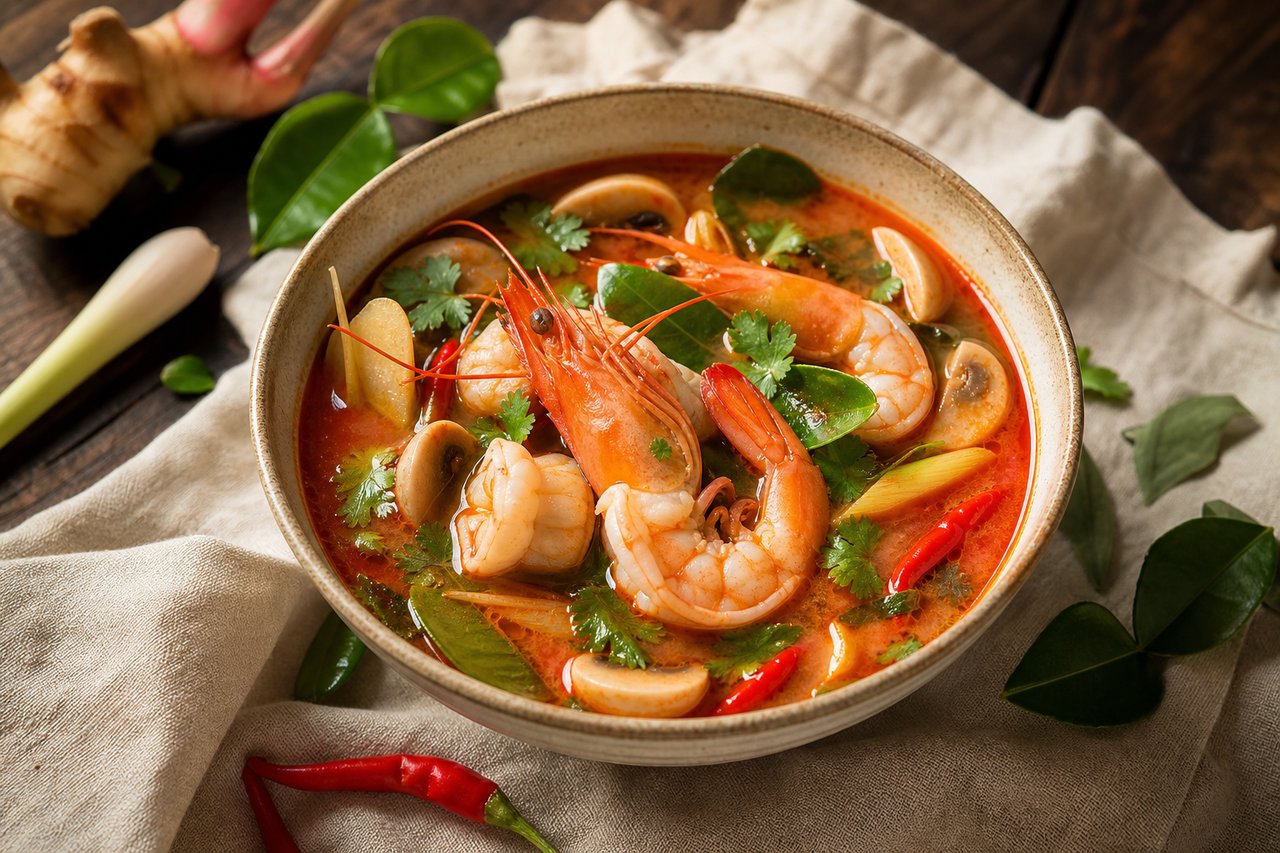
Soup sits at the centre of a Thai meal rather than at its start — a communal bowl shared alongside the other dishes and spooned over rice. The most celebrated is tom yum goong, a hot-and-sour prawn soup built on a fragrant broth of lemongrass, galangal, kaffir lime and chilli, sharpened with lime and fish sauce. It is the four-flavour balance in liquid form, and like the salads it shows itself instantly if the seasoning is off.
The aromatics here are bruised and steeped rather than eaten — they are usually left in the bowl as a fragrant signal of how the soup was built. Tom kha, its cousin, softens the same base with coconut milk for a creamier, gentler result. Both come together quickly once the broth is right, which is why soup is a regular part of even a simple weeknight spread rather than a special-occasion dish.
Rice, the quiet centre
For all the fireworks of curries and salads, rice is the still point that the whole meal orbits. Long-grain jasmine rice, fragrant and slightly clinging, is the everyday choice across central and southern Thailand; in the north and northeast, glutinous (sticky) rice is steamed and eaten by hand, rolled into small balls to scoop up salads and grilled meats. Rinse jasmine rice until the water runs clear, then cook it with a touch less water than you might expect so the grains stay separate and fragrant.
Sticky rice is a different process: soak the grains for several hours, then steam them rather than boil them, traditionally in a conical basket over simmering water. The reward is a chewy, cohesive rice that works as both an eating utensil and a vehicle for sauce. In the regions where it is the staple, the meal is genuinely built around it — diners pinch off a ball, press a dent into it, and use it to scoop up larb or som tam.
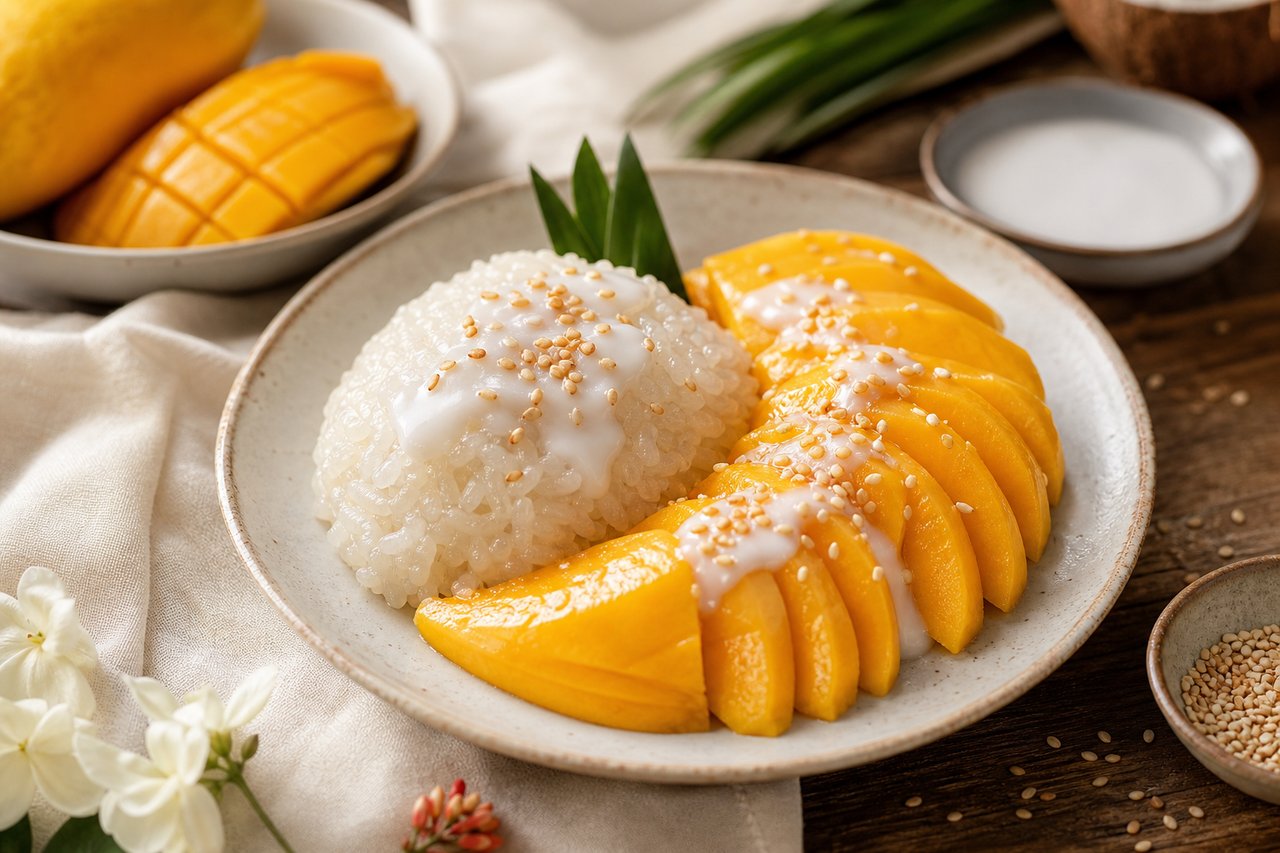
Rice is also dessert. Mango sticky rice — sweet coconut-soaked glutinous rice with ripe mango — is the most beloved sweet in the country, and proof that the same humble grain anchors both the savoury table and its happiest ending.
What a Thai meal looks like
A Thai meal is not a single plated course but a spread of shared dishes eaten together over rice. The aim is contrast across the table: a soup, a curry, a stir-fry and something fresh or sour, so that every mouthful can be tuned by combining them. There is no sequence of starter and main; everything arrives at once, and diners take small amounts of several dishes with each helping of rice, returning to whichever they want next.
That structure is why balance matters not only within a dish but across the meal. A rich coconut curry is offset by a sharp salad; a fiery stir-fry is calmed by plain rice and a mild soup. Planning a Thai meal is really planning a set of contrasts. Get the rice, the pantry and the habit of tasting right, choose dishes that pull in different directions, and the rest of Thai home cooking follows.